UMD's Quantitative Biology Initiative Announces Inaugural Postdoctoral Fellow Cohort
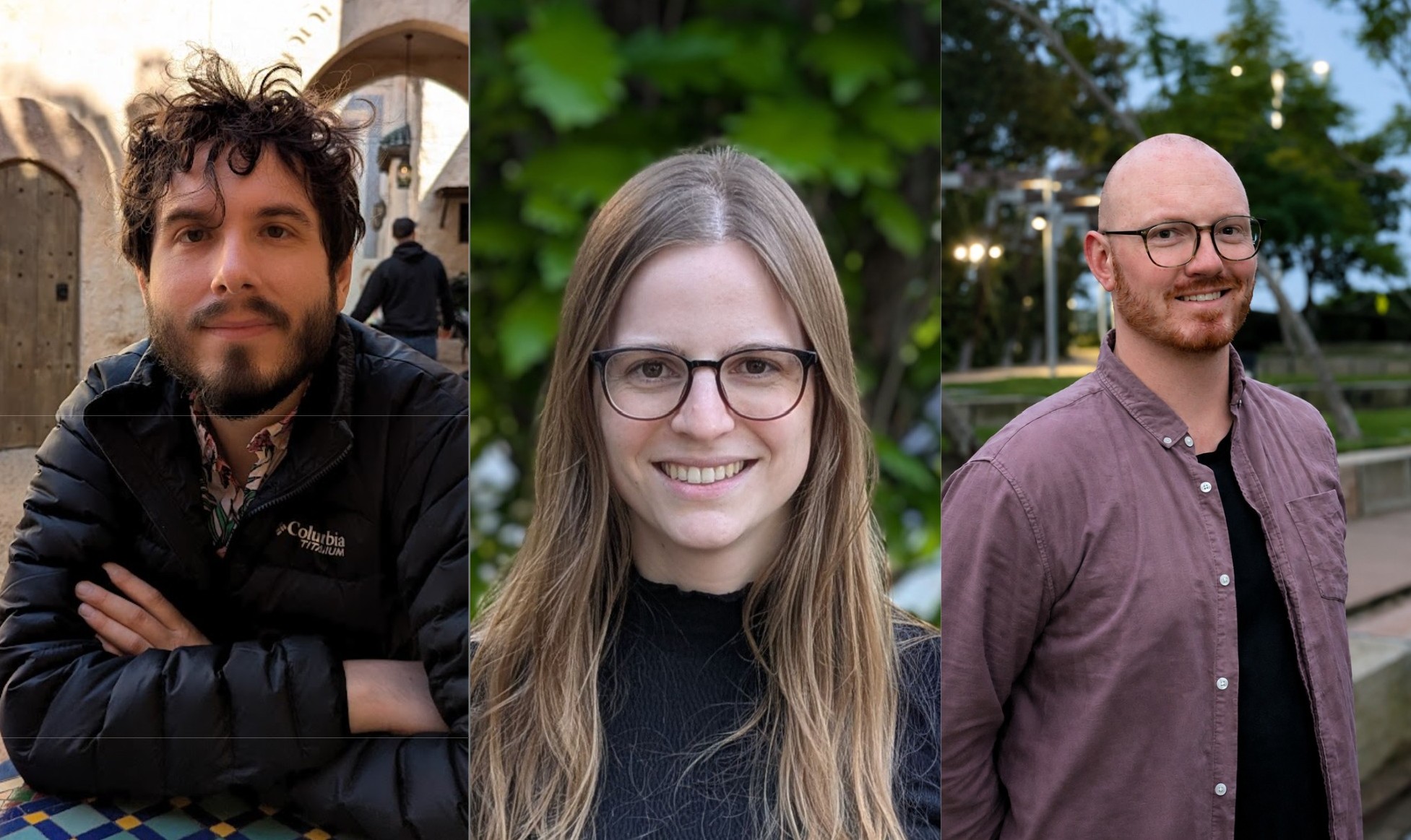
Three fellows have been named as the inaugural cohort of the University of Maryland’s Quantitative Biology Initiative (QBI) Postdoctoral Fellow Program. Spencer Hobson-Gutierrez, Julie Pourtois and James Richardson will work with QBI faculty, staff and students for three years to address critical issues in the life sciences using quantitative approaches.
“Postdoctoral fellows hold a unique position in academia: they have the skills to push at the forefront of research but aren’t hindered by the other time-consuming obligations that come with a faculty position,” said Philip Johnson, who chaired the Department of Biology's search committee for the fellow program. “I am excited for our first cohort to be the catalyst for our collaborative QBI efforts in both research and education.”
The QBI was launched earlier this year by the Department of Biology to advance quantitative approaches to biology through both research and community-centered training for faculty, students and staff. An integrative approach to addressing outstanding questions is at the forefront of the Initiative, and the diverse interests of the inaugural postdoctoral cohort reflect the range of research directions among the program’s faculty mentors: Emme Bruns, Bill Fagan, Johnson, Vadim Karatayev, Jeff Maltas and Joshua Weitz. In addition to doing their research, each fellow will develop and teach an undergraduate-level course that uses quantitative approaches to teach biology concepts.
The fellowship program will recruit new postdocs biennially, with each cohort lasting a three-year term.
“I’m excited that we’ve created an environment in which junior scientists can learn by working collaboratively with experts with different focal areas,” said Joshua Singer, chair of the Department of Biology. “Our first QBI cohort will allow us to advance truly multidisciplinary research and teaching programs.”
Hobson-Gutierrez is currently completing his Ph.D. in biology at New York University, where he is studying cell biology, population dynamics and inheritance. He has a strong quantitative background with undergraduate degrees in mathematics and physics and a master’s degree in mathematics. At UMD, he plans to continue studying quantitative aspects of cell biology, with a particular focus on how antibiotic resistance correlates with genetic lineage. He intends to structure his teaching around mathematical and computational tools applicable to a range of biological scenarios.
“QBI is one of the rare programs that treats theory and quantitative reasoning as central to biology rather than auxiliary to it,” Hobson-Guitierrez said. “The opportunity to spend several years embedded in that kind of environment is exciting.”
Pourtois will join the QBI fellow program after nearly two years as a postdoc in Weitz’s lab to expand her mentorship and research opportunities. She received her Ph.D. in biology from Stanford University and studied ecology and evolution as an undergraduate. Her research as a QBI fellow will focus on viral infections in bacteria, specifically examining how temperature changes affect virus-host dynamics and coevolution, such as in cyanobacteria in the ocean under the pressures of climate change. In her teaching, she aims to build a course that highlights quantitative methods in ecology, with a focus on foundational models.
Pourtois looks forward to meeting other fellows, getting to know her co-advisor, teaching and joining a formal program that centers on quantitative biology.
“Being part of the first cohort, it really feels like it is possible to have a big impact on how the program develops in the future,” she said.
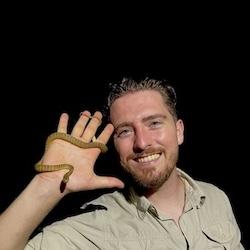
Richardson is finishing his second Ph.D. at the University of Queensland in Australia, where he is studying ecology. His first Ph.D. and earlier degrees are in mathematics, reflecting his interest in the quantitative underpinnings of ecology. He studies how different species coexist and will use theoretical and empirical methods to investigate how fluctuating environmental conditions affect coexistence and evolution. He is interested in teaching an introductory course on how to build models of ecological phenomena.
“I'm looking forward to the opportunity to collaborate with researchers with a range of interests and backgrounds, all working on different aspects of quantitative biology,” he said. “I also appreciate the opportunity to put together a specialized course, exploring the fascinating intersection between mathematics and natural history.”