
Steering Evolution to Prevent Disease
Biology Assistant Professor Jeff Maltas combines math and lab work to study how drug resistance evolves in cancer and pathogens.
Biologist Jeff Maltas spent the last six years studying a deadly form of lung cancer. His research focused on tumors containing cells that express a protein called epidermal growth factor receptor (EGFR), which helps cells grow and divide, making the cancer harder to fight.
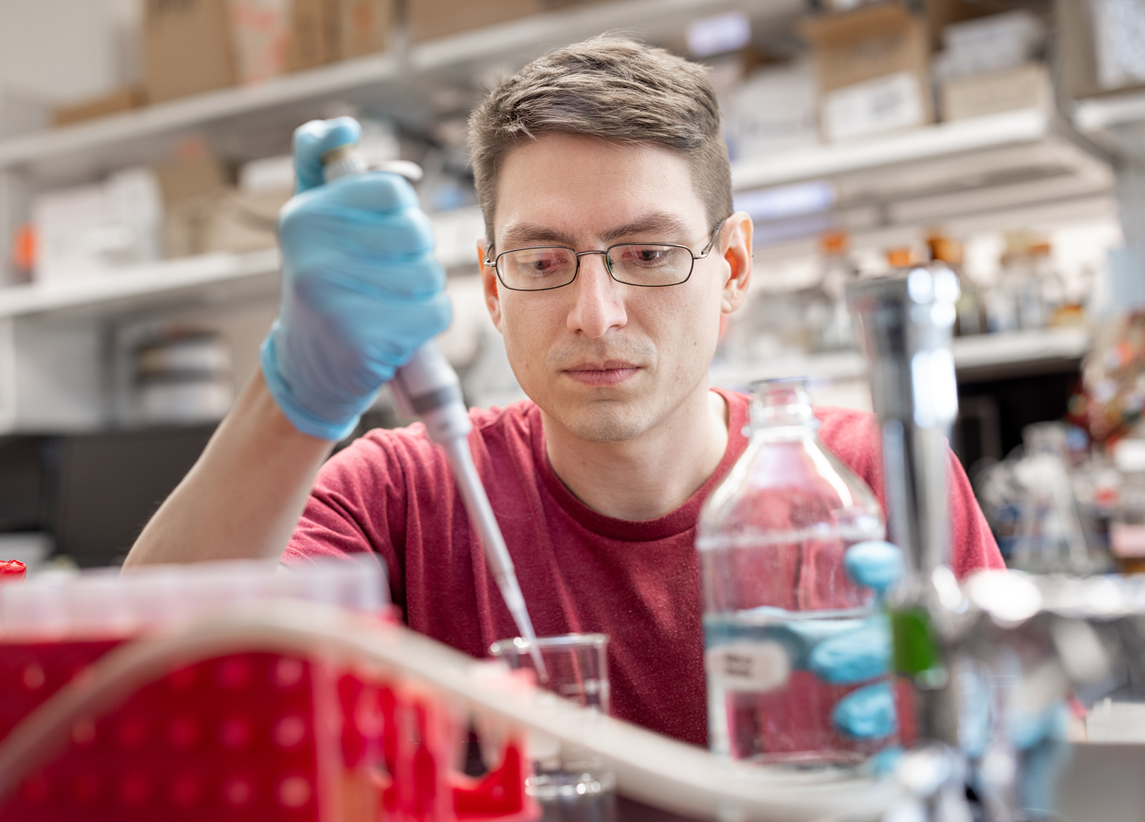
Lung cancers driven by EGFR tend to afflict non-smokers, and they’re highly resistant to treatment. Targeted therapies for EGFR-driven cancer exist, and they work well for about a year. But almost inevitably, Maltas said, the cancer returns in a drug-resistant form.
“If it’s metastasized, it has a nearly 100% recurrence rate,” said Maltas, a new assistant professor in the University of Maryland’s Department of Biology. “You can’t kill it with drugs.”
To Maltas, the findings presented a conundrum. They suggest that nearly all tumors contain drug-resistant cells at the start of treatment. But according to early research, those drug-resistant cells shouldn’t persist for long. That’s because when resistant cells are isolated and grown in the lab, they grow much more slowly than drug-susceptible ones. Maltas’ calculations suggested that resistant cells should be swiftly outcompeted and eliminated.
"We have this paradox where we know these resistant mutants are there, but evolutionary theory suggests they shouldn't be there," he said.
Maltas discovered an explanation when he grew drug-sensitive and resistant cells in the lab in tandem, in what’s called a co-culture. When the two different cell types mingled—and especially when the resistant cells made up a small share of the mix, as they might early in the cancer’s progression—they had roughly the same growth rate. The drug-sensitive cells give the drug-resistant ones a “helping hand,” Maltas said, keeping them around in the tumor.
The result helps explain why this particular lung cancer is so hard to cure. It also exposes a blind spot in the field. Few people study resistant and sensitive cancer cells together, Maltas said, even though that's how they exist in patients. Maltas’ research program shines a light on those population interactions, showing how they affect evolution, including in tumors, bacteria, viruses and fungi. His goal is to predict evolution—and potentially control it to eliminate hard-to-treat forms of disease.
"We know shockingly little about predicting evolution,” Maltas said, “precisely because we haven't sufficiently investigated the timescale where ecology and evolution intersect.”
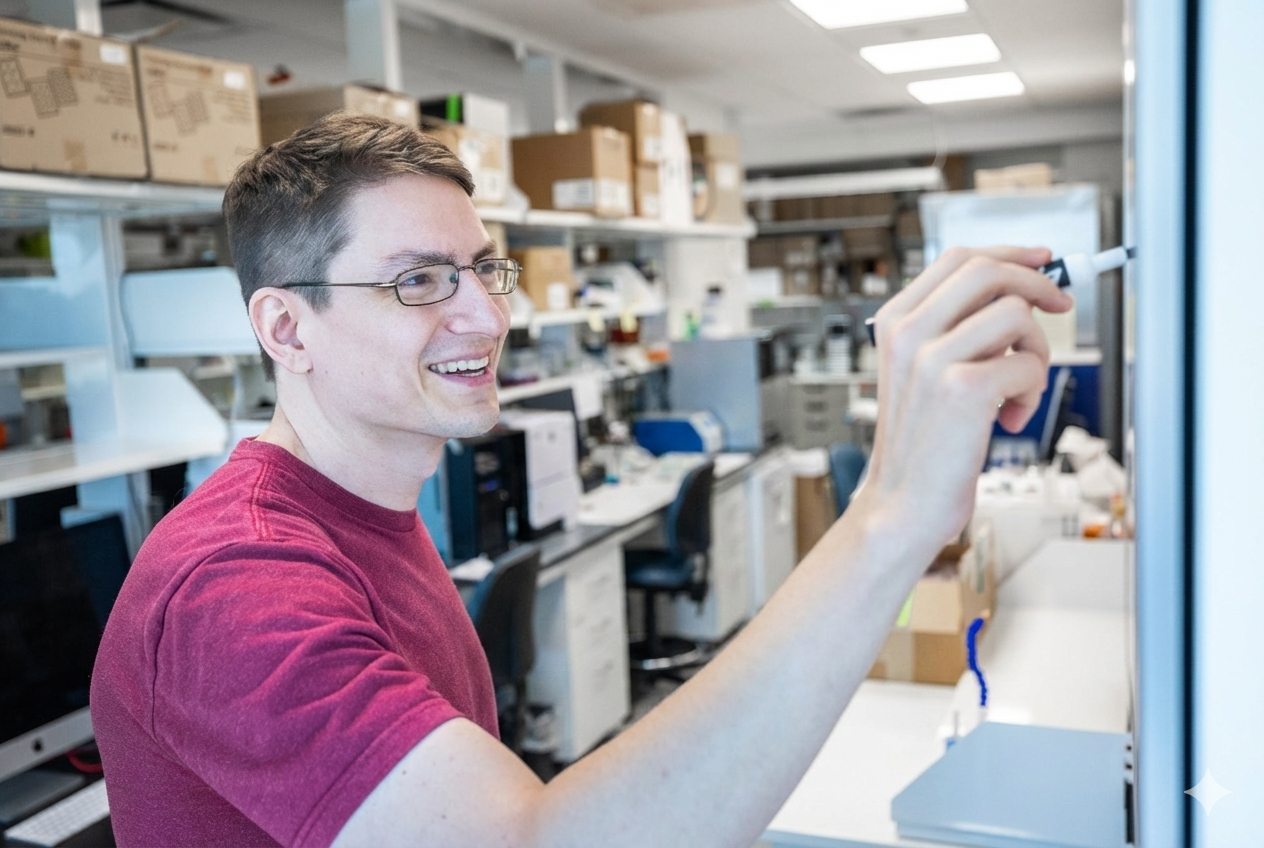
The motivation for Maltas’ research dates back to fifth grade, when his mother, Courtney, was diagnosed with breast cancer. She passed away while Maltas was in college. To that point, Maltas was involved with cancer-related fundraising and volunteer opportunities, but his mother’s passing compelled him to do more. A physics major at Marquette University at the time, he quickly pivoted to biological research, earning a master’s degree in physics from Miami University and then a Ph.D. in biophysics at the University of Michigan.
Maltas’ Ph.D. research focused on drug resistance. He studied a phenomenon called collateral sensitivity, in which a population evolves resistance to a drug and, as a side effect, becomes more sensitive to other drugs. This means that the order of medications matters as much as the ones chosen. If doctors choose the sequence wrong, the disease could become more resistant to the medications they’d want to administer in the future, and vice versa. Maltas’ research aimed to identify the rules and patterns governing this collateral sensitivity, drawing on evolutionary modeling and wet lab experiments.
After finishing graduate school, Maltas became a postdoctoral researcher at the Cleveland Clinic and Case Western Reserve University, extending his evolutionary biology program to include ecology. He studied how interactions among different cell populations affect their evolution—for example, using game theory to model how different types of lung cancer cells affect each other's growth rates.
Maltas said his physics training has been instrumental to his success in biology research. It equipped him with a rigorous quantitative toolkit and a versatile problem-solving process. Additionally, he said that because statistical physics is all about how small particles interact to give rise to system-level properties, this translates well to studying how different cells interact to give rise to population-level properties.
“The questions are quite similar, and as a result, the math is quite similar,” Maltas said.
At Maryland, Maltas is building a lab that blends computational and experimental work, something he jokingly calls a "soggy lab—not quite wet, not quite dry." He plans to continue his work on cell population interactions and collateral sensitivity, and because his work is inherently interdisciplinary, he will recruit trainees from diverse academic backgrounds.
"I need everything," from ecologists and molecular biologists to mathematicians and computer scientists, he said.
Ultimately, Maltas hopes his work will persuade the scientific community that ecological interactions are more important to disease evolution than currently appreciated.
"I want to convince the field that these interactions are more abundant than they think," he said. “Understanding them is required if we ultimately want to predict and control evolution in an effort to cure diseases like COVID-19, influenza, cancer, MRSA and more.”