Decoding Giant Honey Bee Defense
UMD biological sciences Ph.D. student Gayatri Anand develops mathematical models to understand how hundreds of giant honey bees ‘shimmer’ in perfect synchrony to protect their hive.
When predators approach a giant honey bee colony, something remarkable happens. Hundreds, if not thousands, of bees rapidly flip their abdomens upward to create what appears to be ripples across the surface of their open nest, like sports fans doing the ‘wave’ in a stadium. This defensive behavior, known as ‘shimmering,’ serves as a visual warning system that protects the colony from threats like wasps.

For Gayatri Anand, a fourth-year biological sciences Ph.D. student at the University of Maryland, this phenomenon represents a fascinating example of emergent behavior—how simple interactions between individual animals can create complex, population-wide patterns.
“It’s a really interesting system to study self-organization, or how interactions between individuals can lead to really complex collective actions,” Anand explained. “To understand this complex dynamic, I build models that simulate how these coordinated wave patterns emerge from the actions of hundreds of individual bees.”
Giant honey bees (Apis dorsata), native to tropical and subtropical regions of South and Southeast Asia, build exposed, single-comb nests that hang from tree branches or building overhangs. This open nesting makes the bee colonies particularly vulnerable to predators, leading to the evolution of several sophisticated defensive strategies including ‘heat balling’ (raising their body temperatures to kill wasps after surrounding them in a ball) and shimmering.
What makes shimmering especially intriguing is how it functions. When certain ‘trigger center’ bees detect an incoming threat, they quickly flip their abdomens upward, and this behavior spreads contagiously to surrounding bees. The bees then experience a brief refractory period after participating, during which they won’t respond to the same cues to shimmer. The combination of these behaviors results in various wave patterns across the colony.
“The bees can create circular waves, spiral waves or just many different patterns and shapes with their coordinated movements depending on the situation,” Anand said. “Sometimes the speed with which this happens is so fast that it looks like they all flip their abdomens in perfect synchronization.”
Researchers like Anand believe that shimmering serves multiple purposes. For example, the coordinated movements might confuse predators by making the colony appear to be a larger organism. Shimmering could also alert other bees to incoming threats. Interestingly, the bees use different defensive tactics depending on the predator: while they shimmer against smaller threats like hornets, they resort to mass stinging when larger predators like birds approach. Through the research she’s conducting in the laboratory of William Fagan, Distinguished University Professor of Biology, Anand hopes to provide a clearer understanding of how honey bees deploy these defense tactics.
“We think that the bees won’t risk the structural integrity of their hive, so they’ll likely avoid using shimmering to defend against birds and just sting the bird instead to keep it far away from the hive,” Anand said. “Figuring out how the giant honey bees communicate these strategies among themselves is something that is incredibly fascinating.”
Anand developed mathematical models of shimmering that represent the honey bee colony as a matrix, with each cell representing an individual bee. Each bee can be in one of three states: neutral (not participating), active (abdomen raised to shimmer) or refractory (temporarily unable to respond).
“My models simulate how the bees react and interact,” Anand explained. “When one of the matrix cells turns ‘on,’ the cells around that cell turn on in the next time step. Like a domino effect, this continues until the cells gradually enter the refractory phase.”
Anand hopes to improve her model by refining it with more accurate biological parameters. She plans to capture high-resolution, high-frame-rate videos of giant honey bee shimmering in action. Anand’s work will build on previous research by international collaborators that found that shimmering is triggered by specific visual stimuli—particularly dark objects moving against bright backgrounds, which closely resembles the appearance of flying predators against the sky.
“To artificially trigger shimmering, I plan on using dummy wasps on the bees,” Anand said. “From there, I’ll be able to study how waves propagate across the colony, see which bees participate and how various communication patterns form around the hive.”
While the immediate goal of her work is to understand giant honey bee defense communication and behavior, Anand noted that the principles of her research have much broader applications. Similar self-organizing collective behaviors occur often in nature, from schools of fish swimming to flocks of birds soaring together in the sky.
“As exciting as Gayatri’s research on the giant honeybees is, it is perhaps more remarkable that those efforts are only one part of her dissertation,” Fagan noted. “She is simultaneously working on other interesting projects involving the statistical analysis of animal movement data.”
Anand’s efforts were recently recognized by the Ecological Society of America, which awarded her the E. Lucy Braun Award for Excellence in Ecology for a poster on a novel technique to estimate animal population ranges—work that combined statistical modeling and computer simulations to improve upon existing methods.
For Anand, learning more about the interplay between collective communication and behavior has far-reaching implications.
“We humans have this sort of behavior as well. The types of models and theories that have been applied to this research have also been extended to, for example, the way humans navigate crowds or traffic moves on roads,” Anand added. “An individual can only take in cues from the individuals immediately surrounding them, but somehow they respond appropriately. And when you have many different individuals following these rules, you get these interesting emergent behaviors.”
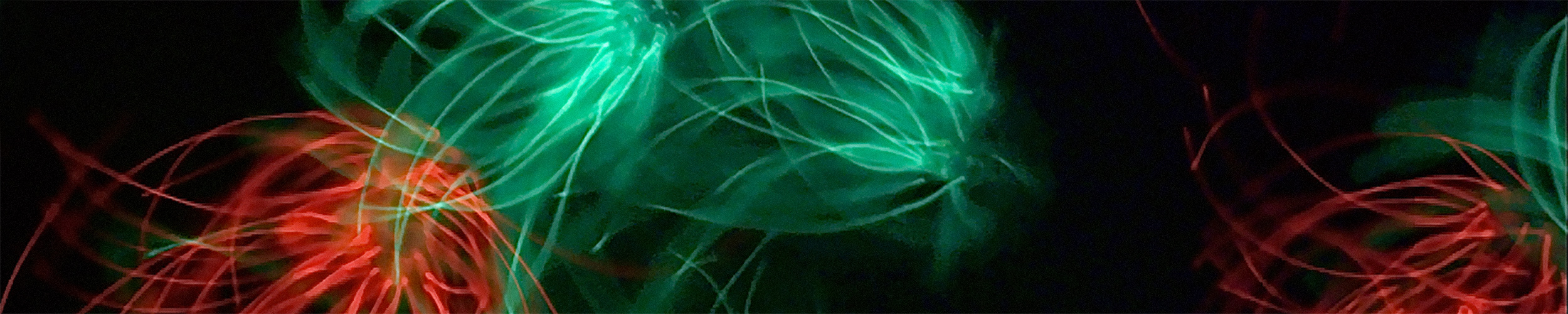
Bee shimmering experiment by Gayatri Anand