UMD Was Sylvester Gates III’s ‘Second Home.’ Now It’s His Ph.D. Alma Mater.
A childhood spent following their father around the halls of UMD’s Department of Physics led twins Sylvester and Delilah Gates to scientific careers researching the brain and the cosmos.
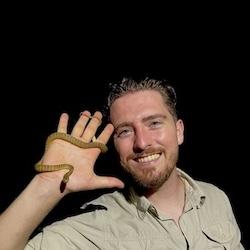
When Sylvester James Gates III (B.S. ’15, biological sciences) graduates from the University of Maryland with his Ph.D. in biological sciences this month, it will be a family affair—and a homecoming.
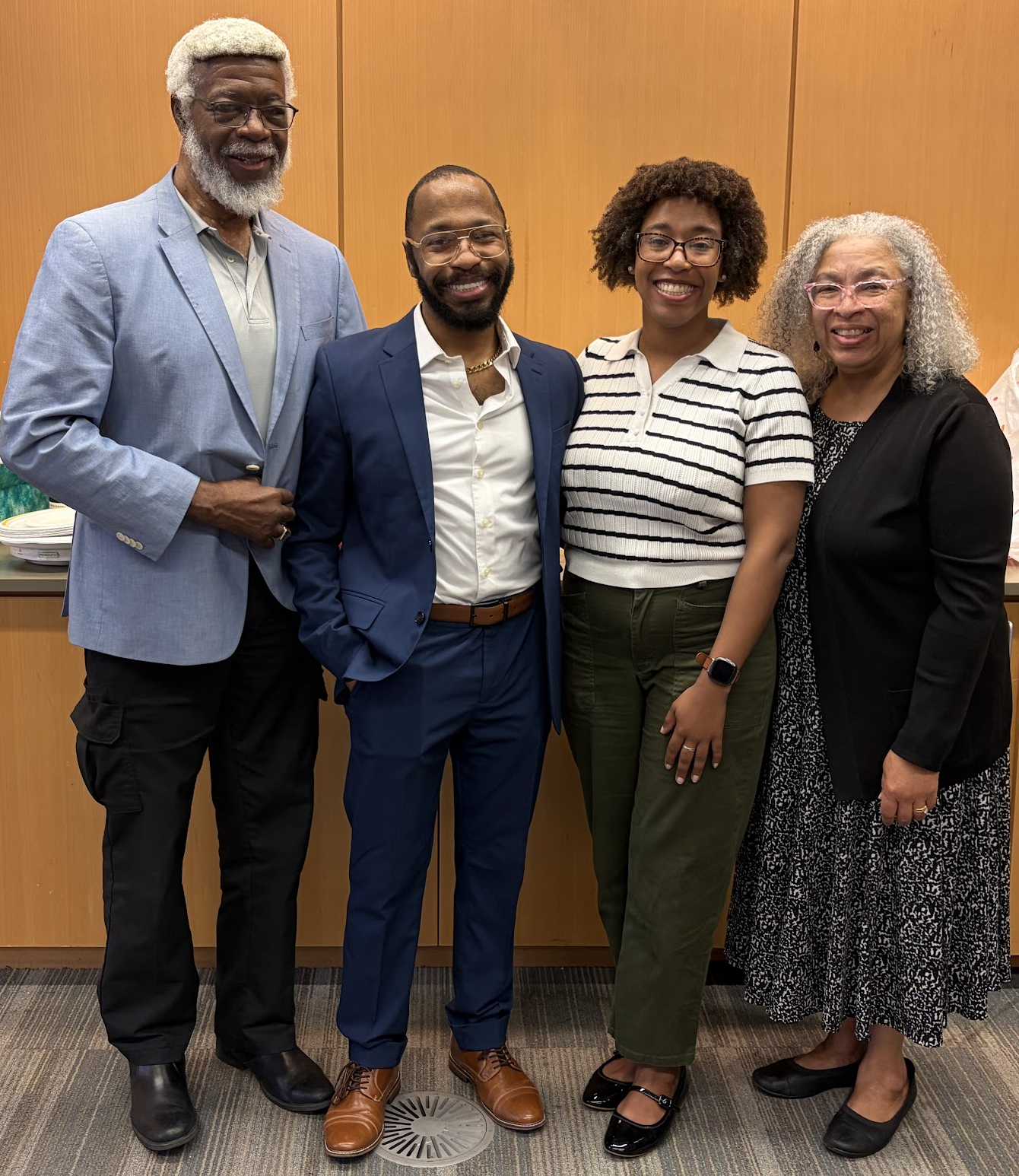
Sylvester grew up near College Park. His father, Distinguished University Professor of Physics Sylvester James Gates Jr., who goes by Jim, holds the Clark Leadership Chair in Science and has been at UMD since 1984. As kids, Sylvester and his twin, Delilah Gates (B.S. ’15, physics; B.S. ’15, mathematics), spent their free days with their dad in the John S. Toll Physics Building.
“The university always felt like a second home to me,” Sylvester said.
So it was no surprise that both twins chose to stay in College Park for their bachelor’s degrees and they both became scientists.
After graduating from UMD, Delilah earned her Ph.D. in physics from Harvard University in 2021, where she studied black holes in space. She completed a Future Faculty in the Physical Sciences Fellowship at Princeton University and then returned to Harvard as a postdoctoral fellow at the Center for Astrophysics | Harvard & Smithsonian and a member of the Black Hole Initiative.
Sylvester, meanwhile, spent a brief stint in graduate school at Duke University before returning to Maryland for his Ph.D., where he studied how brain cells communicate. Working with Physics Professor Wolfgang Losert, Sylvester’s Ph.D. research developed new, nontraditional ways to measure brain cell activity—for example, by monitoring ions, stress compounds and the cell’s internal skeleton. He argues that gaining a more holistic picture of how the brain works could lead to more powerful artificial neural networks for computing and better drug discovery for brain diseases.
When Sylvester presented this work during his dissertation defense in April, his whole family came to campus to watch. This month, they’ll return once more to cheer him on as he walks across the graduation stage. The milestone marks the end of a challenging but rewarding graduate school journey.
“I'm incredibly proud of Sylvester,” Delilah said. “He's an amazing guy, as both a scientist and a human.”
Two Science Terps Are Born
What exactly does a kid do when they’re dragged into a university physics building? Actually, quite a lot, Sylvester and Delilah said.
They have fond childhood memories of playing with physics demonstrations, mingling with employees and learning Japanese from a department staff member. Delilah even recalls playing physicist—much like many kids play doctor—scribbling gibberish on her dad’s blackboard and notepads as she pretended to do complex calculations.
In many ways, the twins took after their parents. Their mother, Dianna Abney, is a pediatrician, child abuse specialist and the health officer for Charles County, Maryland. Like the kids, one of their parents studies physics, and the other is in the life sciences. Still, neither kid felt pressured by their parents to be scientists. In fact, both twins played the clarinet and considered majoring in music at UMD.
“Though I have been deeply passionate about reaching my wish of becoming a scientist starting at age 4—as is similar to the case of my wife, Dianna, whose wish to become a medical doctor began around age 8—we shared a belief that parents should provide a safe environment with some structure, but stay out of the children's lanes of determining their lives' ambitions,” Jim said.
That’s not to say Jim and Dianna did not influence their children’s careers at all. They were friends with other doctors, professors, lawyers and people with advanced degrees. Being around them helped the twins understand what went into pursuing those career paths, Delilah said. And, they were always invited to chat with the adults.
“A lot of things that some people might think are hard discussions about science, the universe, planets, biology and medicine were commonplace, because that's just the language my mom and dad spoke,” Sylvester said.
He added that representation was important.
“It never felt like science was unapproachable to me,” Sylvester said. “This is one of the reasons why I believe that representation matters. Having a father and mother who were, respectively, a physicist and a pediatrician, both doctors in their own right, made being a doctor seem like something that my sister and I could do.”
Diverging Disciplines
Now that they’re both scientists, the twins study the world on vastly different scales—Sylvester works on microscopic cells, while Delilah researches the vast cosmos. The two siblings always had distinct dispositions, Sylvester said. He was always more artsy, and his sister was more drawn to math. So, he’s not surprised their interests diverged.
Delilah initially planned to study particle physics like her father, but after taking a cosmology class in graduate school, she became fascinated by black holes. She was drawn to the discipline’s strong mathematical framework, which, like particle physics, builds on concepts like field theory and general relativity. Now, as a theoretical physicist, she’s developing new ways to measure the spin of black holes—a question that has vast implications for understanding how galaxies form and evolve.
As for Sylvester, when he went to Duke University, he was planning to study cancer for his Ph.D. But living away from Maryland for the first time, he experienced culture shock—from the slower pace of life and the distance from the community he had spent two decades developing. For a year and a half, he struggled with his mental health and imposter syndrome.
“Then, I was like, ‘I cannot do graduate school at this point in time,’” Sylvester said. “So I came back to Maryland. Thankfully, I had great support, so I was able to rebuild my scientific confidence.”
Growing Together by Moving Apart
It was difficult for Delilah to watch her twin struggle, but ultimately, it brought them closer. Until that point in their lives, they had lived close enough to see each other and speak regularly. But they had to learn to be there for each other now that they lived hundreds of miles apart.
“Him having struggled taught us how to support each other in a new way,” Delilah said. “It was difficult at first learning to be in different places and on different timelines, but it taught us a new way to communicate and connect.”
When Delilah faced her own challenges about halfway through graduate school, that bond was invaluable.
“I always say I don't think I'll have a midlife crisis because I went through graduate school. I was struggling quite a lot. I was having severe anxiety. And it was to the point I would cry every day, sometimes several times a day,” she said. “I remember I used to call Sylvester most mornings and talk to him on the way to work, because talking to him made me less anxious.”
After supporting each other through tough times, the twins are closer than ever. They’re best friends and speak every day, whether that’s through text messages, phone calls or wordless exchanges of memes. After watching Sylvester bounce back from his struggles, Delilah was overjoyed as she watched her brother finally defend his Ph.D. It was her first time watching him deliver a scientific lecture, and she noted how calm, cool and collected he was—and also how well-dressed.
“He's so much more fashionable than me,” she said with a laugh. “He looked really sharp.”
Delilah got emotional as she recounted the day’s events.
“I was the last one he shouted out in detail in his acknowledgments, and I just bawled. I couldn't contain my joy and pride. I was so happy for him,” she said. “Even thinking about it now, I get a little verklempt.”
Their father felt the same way.
“It would take me writing a magnum opus to really express my feelings in the defense,” Jim said.
Now that he’s completed his Ph.D., Sylvester is still figuring out what’s next. He’s open to academia, or maybe a career in government or industry. Wherever he lands, he wants to continue studying how the brain works, whether that means developing artificial neural networks for computing, medicines for neurodegenerative diseases like Alzheimer’s or interventions to help military veterans dealing with brain trauma.
And although the twins’ physics professor dad never pushed either child to pursue science, he’s thrilled by their accomplishments now that they have chosen the path for themselves.
“Raising them was amazing. My wife and I still say that there is nothing else in life that we have done that was more fun,” Jim said.
It’s hard for him to find the words to describe how he feels witnessing his children’s success. So, he turns to something of a family heirloom—cherished words his father once shared with him.
“After I became the John S. Toll Professor of Physics, my father said to me, ‘You have exceeded any and all expectations that your mother, Charlie, and I ever had of and for you,” Jim said. “My twins have accomplished that also for their parents.”