Reborn to Be Wild
Once on the brink of extinction, the scimitar-horned oryx is making a comeback in the savannahs of Africa—and UMD scientists are waiting to see if this new generation of animals still remembers its wild instincts.

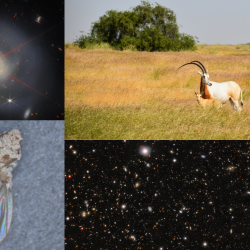
In 2000, the International Union for Conservation of Nature made it official: the scimitar-horned oryx, a horned antelope that once abundantly roamed the grasslands fringing the Sahara Desert, was functionally extinct in the wild. Hunting and habitat loss from increasing human activity in the region erased hundreds of thousands of oryx from the landscape within a matter of decades. Only those living in captivity survived.
But just over 20 years later, the union decisively reversed its assessment, downlisting the species to “endangered” status—a distinction that carries real consequences. For governments and funders, it can shift how resources are allocated and which protections remain in force. And for the species itself, it marks a rare and meaningful step back from the brink of permanent loss. The reversal came thanks to a global coalition of governments, conservation organizations and researchers that reintroduced these animals from captivity back into the wild.
University of Maryland biological sciences Ph.D. student Gayatri Anand and postdoctoral researcher Marron McConnell (Ph.D. ’26, biological sciences), who work with Distinguished University Professor of Biology Bill Fagan to study movement ecology, partnered with the Smithsonian’s National Zoo and Conservation Biology Institute (NZCBI) to assess the reintroduced oryx population in multiple ways.
“This is one of the very, very rare cases for a large mammal to be brought back from extinction in the wild,” McConnell noted. “Reintroducing these animals from captivity is extremely complex and difficult. Only a few other comparable examples come to mind, such as the Arabian oryx and Przewalski’s horse.”
“It’s one of conservation’s best success stories, so it’s important to find out the long-term consequences of their return,” Anand added. “Have these scimitar-horned oryx changed, in terms of their social behavior or migratory knowledge, from their original wild versions? And if so, how?”
A herd that had to start over
Since 2016, nearly 350 scimitar-horned oryx from the World Herd managed by the Environment Agency-Abu Dhabi have been released into the Réserve de Faune de Ouadi Rimé-Ouadi Achim in central Chad—a protected area roughly the size of Maine. The wild population now numbers around 650-900, with the majority of animals born in Chad. By most typical benchmarks for similar programs, the oryx reintroduction is working.
But bringing a species back from extinction is only the beginning. A harder question remains: Can an animal that has spent generations in captivity actually learn to be wild again?
Around 2022, research ecologists Jared Stabach and Katherine Mertes of NZCBI initiated a collaboration with Fagan and his research group to help answer that question.
Because the species was extinct in the wild for so long, almost everything known about its social behavior came from captive populations—which are typically smaller, sex-biased and managed in fenced enclosures. When the first 21 oryx were released into the reserve in 2016, they entered a landscape with no social world. McConnell was excited to see how the reintroduced animals reformed the social bonds that build an organized population.

“They had to construct a society from scratch,” explained McConnell, whose research focus is on animal social dynamics. “I study how the new oryxes did that, how it grew over time, and how the structure and demographics of these social modules developed.”
To trace that development, McConnell drew on a mix of daily observations by a full-time field monitoring team, genetic analyses documenting kinship among the oryx released into Chad and GPS collar data. Her analysis found that reintroduced oryx were a particularly “gregarious species.”
“The oryx love communicating with each other, but they don’t form fixed herds,” McConnell said. “Instead, they move through what ecologists call ‘fission-fusion’ dynamics—constantly mixing, splitting apart and reforming into new groupings.”
Anand’s research takes on a different mystery: migration. Historically, this species of oryx is believed to have followed seasonal “green waves”—pulses of vegetation growth that move north through the grasslands along the Sahara Desert, as the rainy season progresses.
But in ungulates (hoofed mammals like the oryx, along with deer, bison and horses), migration isn't instinct. It's culture.
“Knowledge of migratory routes isn't inborn in ungulates. Instead, it’s passed from parent to child, so when a population goes locally extinct, that knowledge disappears with it,” Anand explained. “There are studies of bighorn sheep, bison and red deer that have this same pattern. Without experienced animals to follow, reintroduced populations don’t know where to go.”
Anand found early evidence that oryx may have adapted to their lack of knowledge.
“It looks like there is a learning process going on between these newer generations of oryxes, now that the earliest batch has gained more experience tracking resource waves,” Anand said. “The population is forming complicated social and movement structures to ensure that they get to where they need to go.”
A road map for the future
The wealth of GPS data from reintroduced oryx represents more than just the success of one conservation effort. For Fagan’s group and many other movement ecologists worldwide, this project is just the beginning.
“The oryx dataset has years and years of crucial information about these animals just waiting to be found,” McConnell said. “From what we’ve worked with in the movement data, we’re able to access insights into things like their social structures, adaptive behaviors and even potential emergency warning signs for future disease events.”
“Lessons learned here are extremely applicable to other similar animals living in seasonally variable landscapes,” Anand added. “This work can also serve as a roadmap for future reintroductions of other species elsewhere, potentially bringing back other functionally extinct animals from extinction.”
###
The Oryx Reintroduction Project in Chad is a joint initiative of the government of Chad and the Environment Agency‑Abu Dhabi. Under the overall leadership and management of the Environment Agency‑Abu Dhabi, on-the-ground implementation of the project is carried out by Sahara Conservation. The Smithsonian Institution extends its gratitude to the government of Chad, the Environment Agency-Abu Dhabi and Sahara Conservation for the opportunity to assist in the project’s implementation.