

Biography
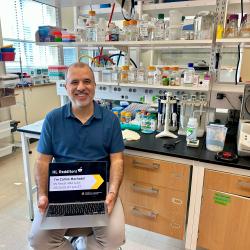
Eric is an evolutionary developmental biologist who joined UMD's Department of Biology in 2002 after undergraduate study at Oberlin College, doctoral work at Indiana University, and post-doctoral research at the University of Wisconsin. His work explores the evolution of reproductive traits in animals, primarily using Caenorhabditis nematodes as a model genus. The main focus is on the genetic and molecular causes of self-fertile hermaphroditism, and the genomic and reproductive consequences of adopting it. Methodologically, the Haag Lab strives to be integrative by combining forward and reverse genetics, comparative genomics, molecular and cell biology, and even some theory to produce comprehensive pictures of evolutionary processes.
Teaching
- BSCI170: Principles of Molecular & Cellular Biology
- BIOL615: Developmental Genetics
Graduate Program Affiliations
- Biological Sciences (BISI): Behavior, Ecology, Evolution, and Systematics (BEES)
- Biological Sciences (BISI): Computational Biology, Bioinformatics, and Genomics (CBBG)
- Biological Sciences (BISI): Molecular and Cell Biology (MOCB)
Research Interests
Sexual reproduction is an ancient process found across the Eukaryotes. In animals and plants, sex is typically fully outcrossing, whether through hermaphrodites or separate male and female sexes. However, some species abandon outcrossing some or all of the time via uniparental reproduction. Dr. Haag's lab has focused on one of the most experimentally tractable of these, the self-fertile Caenorhabditis nematodes. At least three separate times in this genus, the historically female sex gained self-fertility by the evolution of limited spermatogenesis. Starting with the wealth of knowledge about "the worm," C. elegans, Dr. Haag's research has touched on a number of related topics. A major focus has been on the evolution of germline sex determination (the proximate cause of self-fertilty) and the genetics of convergent evolution. More recently, his group has documented a number of surprising consequences of self-fertility, such as massive loss of genes and hypersensitivity to the harmful effects of cross-species mating. Thus, a simple change in transmission genetics can rapidly, reproducibly, and radically alter other biological attributes of an organism.
Education
- Ph.D., Indiana University, 1997 (molecular, cell, & developmental biology; evolution)
- Postdoctoral Fellow, Univ. of Wisconsin, Madision, 1997-2001 (evolution of nematode sex determination genes)