Biography
I am a neuroethologist and study temporal processing and sound localization in birds and reptiles. I was trained in the Zoology Department at the University of Cape Town, and finished my Ph.D. under the supervision of Walter Heiligenberg at UCSD. I then completed a postdoc with Masakazu (Mark) Konishi at Caltech where I worked on barn owl coincidence detectors and their delay line inputs. At Maryland, we’ve expanded our research to look at the evolution of sound localization circuits in an array of birds and reptiles. We’ve worked on alligators, bird’s closest relatives, and on salamanders, turtles, snakes and lizards. The lizard work in particular is inspired by a collaboration with Jakob Christensen-Dalsgaard from the University of Southern Denmark. We’re currently working to show gecko localization in the field.
My group has ongoing collaborations with colleagues in Germany, tied together by sabbatical support from the Humboldt foundation and by a joint NSF award. We have shown that sound localization circuits are assembled slowly during development, following the growth of the head, and that these circuits are also plastic.
As a former director of the Physiological Systems concentration area of the Biological Sciences graduate program, I recommend both the Neural Systems and Behavior course and the Grass Foundation lab at the MBL in Woods Hole.
Teaching
- BSCI 353: Principles of Neuroscience / NEUR 306: Cellular and Molecular Neuroscience
- NACS 728: Hearing
- BSCI 338E: Neuroethology
Graduate Program Affiliations
- Biological Sciences (BISI): Behavior, Ecology, Evolution, and Systematics (BEES)
- Biological Sciences (BISI): Physiological Systems (PSYS)
- Neuroscience & Cognitive Science (NACS)
Research Interests
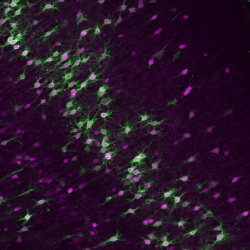
The brain uses time differences (ITDs) between the two ears to localize the sound. The Carr lab studies the neural circuits underlying the computation of ITD in barn owls and other reptiles. In barn owls, we have shown that ITDs are translated into location in space in the brainstem. Detection of these time differences depends upon two mechanisms of general significance to neurobiology, delay lines and coincidence detection. Incoming axons form delay lines to create maps of ITD in nucleus laminaris. Their postsynaptic targets act as coincidence detectors and fire maximally when the interaural time difference is equal but opposite to the delay imposed by the afferent axons. Similar principles guide sound localization circuits in other reptiles.
Current research is focused on models of delay line-coincidence detector circuit, on the assembly of the map of sound localization during development and on how such circuits evolve. All projects develop from initial behavioral observations into systems, cellular and molecular levels of analysis.
Education
- Ph.D., Neuroscience, UC San Diego, 1984
- B.Sc., University of Cape Town, 1976